
Running out of battery on your laptop or smartphone is a nightmare. This ultimate power bank buying guide is exactly what you need.
However, choosing the right portable charger isn’t about the biggest number on the box. Instead, it means matching capacity, wattage output, and charging protocols to your specific gear.
Here is everything you need to know to select the perfect high-capacity portable charger for your modern tech setup.
Quick Answer
Additionally, the Power bank buying guide helps you choose the ideal high-capacity power bank for your devices.
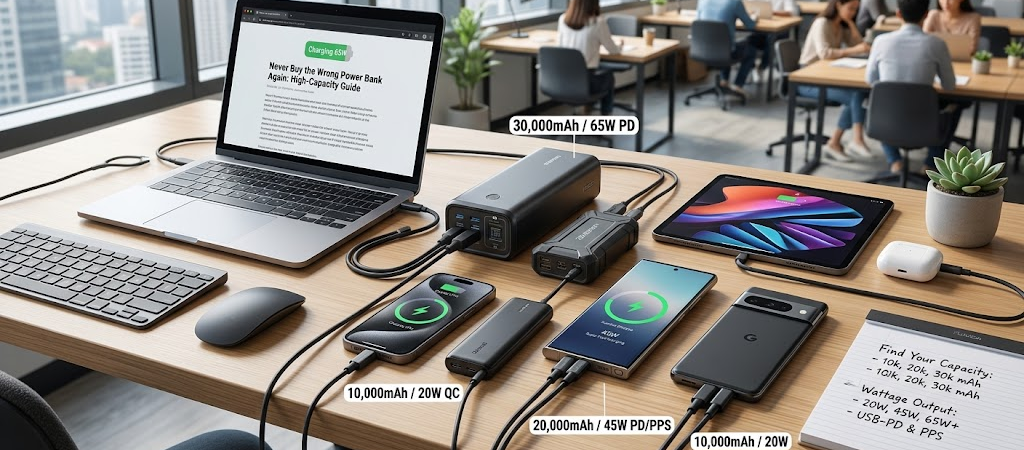
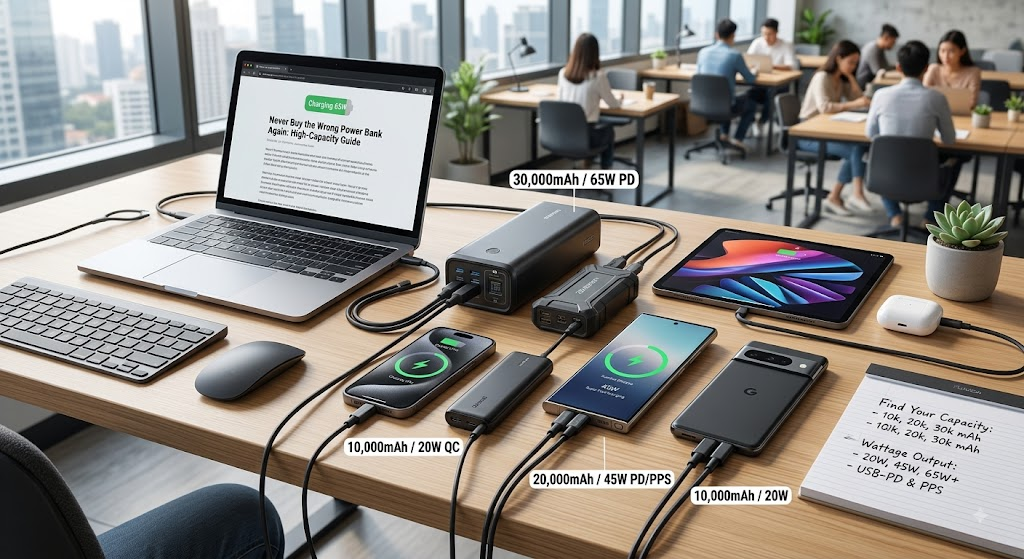
- Capacity (mAh): 10,000mAh for daily smartphone use, 20,000mAh for tablets/travel, and 30,000mAh+ for extended outdoor laptop work.
- Output (W) & Standards: Minimum 20W for smartphones, 45W–65W+ for laptops, with native support for USB-PD and PPS.
- Design & Ports: Prioritize models with at least two USB-C ports, a Digital Battery Display, or Built-in Cables.
- Airline Rules: Ensure the total energy is strictly below 160Wh (approx. 43,000mAh) for carry-on compliance.
Method 1: Determining the Right Battery Capacity (mAh) for Your Routine
Selecting the right capacity ensures you carry enough juice without adding unnecessary weight to your bag.
- Assess your primary device setup. For basic daily use (charging a smartphone roughly twice), select a 10,000mAh power bank.
- If you travel with both a smartphone and a tablet, or plan overnight trips, step up to a 20,000mAh model.
- For digital nomads, campers, or freelancers who need to run power-hungry laptops outdoors for hours, choose a 30,000mAh or higher unit to eliminate power anxiety.
Method 2: Matching Wattage Output (W) and Fast-Charging Standards
High capacity is useless if your power bank charges your devices at a crawl. You must check the maximum wattage output and fast-charging protocol support.
- Inspect the output specs on the charger label. Ensure smartphone-focused units output at least 20W.
- For laptop charging, select high-output models delivering 45W to 65W or higher.
- Confirm support for USB-PD and PPS fast-charging standards to optimize charging speeds across all modern ecosystems.
Deep Dive: Understanding USB-PD vs. PPS Charging Standards
- USB-PD (Power Delivery): A universal high-power protocol operating over USB-C that dynamically negotiates fixed voltage and current profiles (e.g., 5V, 9V, 15V, 20V) up to 100W (or 240W with Extended Power Range). It is essential for heavy-draw laptops, MacBooks, iPad Pros, and flagship smartphones.
- PPS (Programmable Power Supply): An advanced extension of the USB-PD 3.0 standard. Unlike traditional fixed-voltage charging, PPS continuously adjusts voltage and current in real-time in micro-increments (20mV steps) based on the target battery’s temperature and charge state. This drastically reduces thermal dissipation (heat buildup), maximizes charging efficiency, and unlocks true super-fast charging for compatible smartphones (such as Samsung Galaxy flagship models).
Method 3: Optimizing Port Configurations, Design, and Flight Compliance
Hardware design and airport safety regulations dictate how practical your portable charger will be in real-world use.
- Check the port setup before buying. Opt for a unit featuring at least two USB-C Ports to handle modern multi-device charging simultaneously.
- If you frequently lose or forget cables, pick a model with an Integrated USB-C Cable for hassle-free portability.
- Choose a power bank equipped with a Digital Percentage Display so you always know your exact remaining power.
- Verify safety ratings and airline compliance. Keep your pack under 160Wh (approx. 43,000mAh) to clear airport security, and remember that lithium-ion power banks must stay in your Carry-On Luggage and are strictly forbidden in checked bags.
FAQ
Q: What is the main practical difference between USB-PD and PPS charging? A: USB-PD delivers high wattage using fixed voltage steps (such as 9V, 15V, or 20V), making it ideal for large devices like laptops. PPS is a sub-protocol of USB-PD 3.0 that dynamically fine-tunes voltage in real-time, reducing battery heating and enabling maximum fast-charging speeds on devices like Samsung Galaxy smartphones.
Q: Can I bring a 30,000mAh power bank on an airplane? A: Yes. A standard 30,000mAh 3.7V power bank equals roughly 111Wh, which is well below the TSA and international airline limit of 160Wh. Just remember to pack it strictly in your Carry-On Luggage, as lithium-ion power banks are strictly prohibited in checked baggage.